

Introduction
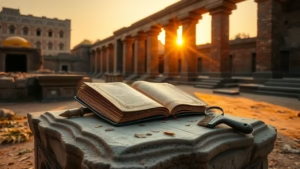
The Lost Golden Library of Vikramaditya remains one of ancient India’s most enigmatic mysteries. Legends speak of a vast repository of knowledge, filled with priceless manuscripts, scriptures, and scientific treatises, hidden somewhere in the subcontinent. Yet, despite centuries of speculation, historians and archaeologists have failed to locate this fabled treasure trove. Was it a myth, or did it truly exist? This unanswered question continues to captivate scholars and storytellers alike.
The Legend of Vikramaditya’s Golden Library
King Vikramaditya, a legendary ruler of ancient India, is often associated with wisdom, patronage of the arts, and immense wealth. According to folklore, his golden library housed knowledge spanning astronomy, medicine, philosophy, and spirituality. Some accounts claim it contained rare texts from across the world, meticulously preserved for future generations. But with no concrete evidence, the library’s existence remains shrouded in myth.
Historical References
Several ancient Indian texts, including the Kathasaritsagara and Brihatkatha, mention Vikramaditya’s grand library. Jain and Buddhist scriptures also refer to his patronage of scholars. However, these accounts blend fact with folklore, making it difficult to separate truth from embellishment.
The Disappearance
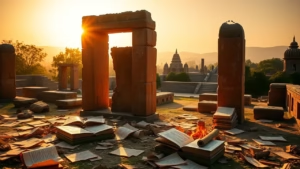
One popular theory suggests the library was destroyed during foreign invasions, particularly by the Mughals or early Turkic rulers. Another legend claims it was hidden to protect its secrets from falling into the wrong hands. To this day, no archaeological findings support any of these narratives.
Could the Library Have Existed?
Many historians argue that India’s ancient centers of learning, such as Nalanda and Takshashila, prove that massive repositories of knowledge did exist. However, the golden library’s description as a structure adorned with precious metals sets it apart, raising doubts about its authenticity.
Comparisons to Other Ancient Libraries
Like the Library of Alexandria, Vikramaditya’s golden library symbolizes humanity’s reverence for knowledge. Yet, unlike Alexandria, there is no physical evidence—no ruins, inscriptions, or relics—egi mabuting that it ever stood.
Possible Locations
Speculations about its whereabouts include:
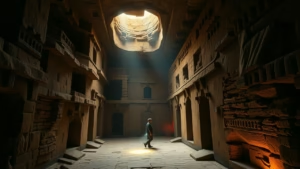
- The caves of Ujjain, Vikramaditya’s capital
- The Himalayas, believed to guard ancient secrets
- Submerged sites along India’s western coast
The Cultural Impact of the Legend
Despite its uncertain existence, the lost golden library has deeply influenced Indian literature and folklore. It symbolizes India’s golden age of learning and serves as a reminder of lost wisdom.
Influence on Modern Literature
Contemporary authors and filmmakers continue to draw inspiration from the legend. Books like The Palace of Illusions and Bollywood epics often reference Vikramaditya’s lost treasures.
Symbolism in Indian Thought
The story represents an idealized past where knowledge was revered and preserved. It also fuels debates about historical preservation and the need to protect ancient manuscripts.
The Search Continues
Archaeologists and historians periodically revisit theories about the library’s location. Advances in technology, like ground-penetrating radar, offer hope that someday, the truth may emerge.
Recent Expeditions
Efforts by organizations such as the Archaeological Survey of India have explored sites like Ujjain and Dwarka, but conclusive proof remains elusive.
The Role of Myth vs. Reality
Some scholars argue that the golden library might be a metaphor for India’s once-flourishing intellectual culture rather than a physical structure.
Frequently Asked Questions
Who was King Vikramaditya?
King Vikramaditya was a legendary emperor of ancient India, celebrated for his wisdom and patronage of scholars. His reign is often associated with a golden age of Indian culture.
Has any part of the golden library ever been found?
No physical evidence has been discovered so far, leaving its existence unverified.
Where is the golden library said to be located?
People speculate about Ujjain, the Himalayas, or submerged coastal cities, but there is no definitive proof.
Why is the golden libraryAxel’s important?
It symbolizes India’s rich intellectual heritage and represents a time when knowledge was highly valued.
Could经济活动去过技术 help locate the library?
Advanced technologies like satellite imaging and地下雷达 may aid future searches, but直到现在e,答案 unknown.
Conclusion
The lost golden library of Vikramaditya remains an enticing mystery, blending history—and myth. Whether真实存在学术争议e truth continues to inspire seekers of knowledge. As India embraces its ancient glory while striding四方的未来,这个传说的library serves as a timeless enigma—one that reminds us of the enduring power of wisdom.