

Introduction
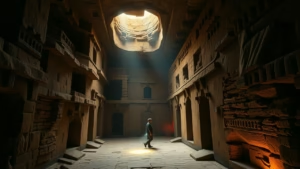
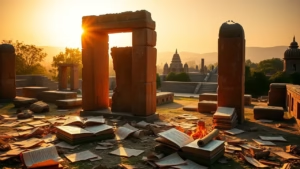
India’s ancient history is filled with enigmatic civilizations, but few are as mysterious as the lost kingdom of Kalinga. Once a formidable warrior society, Kalinga vanished from historical records, leaving behind unanswered questions that baffle historians to this day. From its legendary battles to its unexplained decline, the story of Kalinga is a gripping tale of power, resilience, and mystery. In this article, we delve deep into the shocking truths behind this lost civilization and explore why historians still struggle to explain its disappearance.
The Rise of Kalinga: A Warrior Kingdom
Kalinga, located in present-day Odisha and parts of Andhra Pradesh, was one of ancient India’s most powerful kingdoms. Known for its fierce warriors and maritime prowess, Kalinga thrived as a center of trade and military strength. The kingdom’s influence extended across Southeast Asia, with evidence of cultural and economic exchanges found as far as Bali and Java.
The Legendary Kalinga Army
The Kalinga army was feared across the subcontinent. Historical texts describe their unmatched bravery and strategic brilliance. Unlike other kingdoms that relied on elephants and chariots, Kalinga’s warriors were known for their guerrilla tactics and naval dominance. Their resistance against Emperor Ashoka in the infamous Kalinga War remains one of history’s most brutal conflicts.
The Kalinga War: A Turning Point
The Kalinga War (261 BCE) marked a pivotal moment in Indian history. Emperor Ashoka of the Mauryan Empire launched a devastating invasion, resulting in massive casualties. While Ashoka’s victory is well-documented, the aftermath remains shrouded in mystery. Why did such a powerful kingdom fade into obscurity after the war?
Ashoka’s Conversion and Its Impact
The brutality of the Kalinga War reportedly led Ashoka to embrace Buddhism and renounce violence. However, the fate of Kalinga itself is less clear. Some historians suggest the kingdom was absorbed into the Mauryan Empire, while others believe it retained partial autonomy. The lack of definitive records leaves room for speculation.
The Mysterious Decline of Kalinga
Despite its earlier prominence, Kalinga gradually disappeared from historical narratives. Several theories attempt to explain this decline, but none provide a complete answer.
Natural Disasters and Economic Collapse
Some scholars argue that natural disasters, such as cyclones and floods, devastated Kalinga’s coastal cities. The kingdom’s reliance on maritime trade made it vulnerable to environmental changes. A sudden economic collapse could have weakened its political structure.
Cultural Assimilation
Another theory suggests that Kalinga’s identity was diluted over time due to cultural assimilation. As neighboring empires expanded, Kalinga’s distinct traditions may have merged with broader Indian cultural practices, erasing its unique historical footprint.
Archaeological Clues and Unsolved Mysteries
Modern archaeology has uncovered tantalizing clues about Kalinga, but many questions remain unanswered. Excavations in Odisha have revealed ancient ports, fortifications, and artifacts, yet the full story of Kalinga’s disappearance eludes researchers.
The Lost City of Dantapura
One of the most intriguing mysteries is the location of Dantapura, Kalinga’s legendary capital. Described in ancient texts as a grand city, its exact whereabouts are unknown. Some believe it lies buried beneath modern-day Puri, but conclusive evidence is yet to be found.
Kalinga’s Legacy in Modern India
Though the kingdom vanished, its legacy endures. Odisha’s culture, language, and traditions bear traces of Kalinga’s influence. The famous Konark Sun Temple and Jagannath Temple are testaments to the region’s rich heritage, rooted in its ancient past.
The Revival of Kalinga’s Name
Today, the name Kalinga is celebrated in various forms, from the Kalinga Prize awarded by UNESCO to the Kalinga Institute of Social Sciences. These modern tributes keep the memory of this lost civilization alive.
Frequently Asked Questions
What was the Kalinga War?
The Kalinga War was a brutal conflict in 261 BCE between Emperor Ashoka’s Mauryan Empire and the Kalinga kingdom. The war’s immense bloodshed reportedly led Ashoka to embrace Buddhism and renounce violence.
Why did Kalinga disappear from history?
The exact reasons remain unclear. Theories include natural disasters, economic collapse, and cultural assimilation. The lack of definitive historical records adds to the mystery.
Where was Kalinga located?
Kalinga was situated in present-day Odisha and parts of Andhra Pradesh. It was a coastal kingdom known for its maritime trade and military strength.
What is Kalinga’s legacy today?
Kalinga’s influence persists in Odisha’s culture, language, and traditions. Modern institutions and awards also honor its name, keeping its memory alive.
Has Kalinga’s capital been found?
The location of Dantapura, Kalinga’s legendary capital, remains unknown. Archaeologists continue to search for clues, but no conclusive evidence has been uncovered yet.
Conclusion
The vanished kingdom of Kalinga remains one of India’s greatest historical enigmas. From its rise as a warrior civilization to its mysterious decline, the story of Kalinga captivates historians and enthusiasts alike. While modern research has shed some light on this lost kingdom, many questions linger. As excavations and studies continue, perhaps one day we will uncover the full truth behind Kalinga’s disappearance.