

Introduction
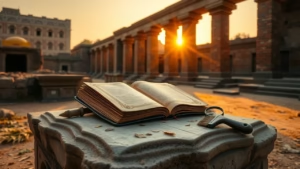
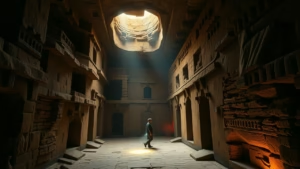
Hidden somewhere in the annals of ancient Indian history lies a mystery that has captivated scholars, archaeologists, and treasure hunters for centuries—the lost Golden Library of Emperor Ashoka. Said to contain priceless texts that could rewrite our understanding of Buddhism, governance, and early Indian civilization, this legendary repository remains one of history’s greatest unsolved enigmas. Why has no one found it? What secrets might it hold? This article delves into the fascinating tale of Ashoka’s lost library and explores why its discovery continues to elude us.
Who Was Emperor Ashoka?
Emperor Ashoka, one of India’s most revered rulers, reigned over the Mauryan Empire from 268 to 232 BCE. Initially known for his ruthless conquests, Ashoka underwent a profound transformation after the bloody Kalinga War, embracing Buddhism and dedicating his life to peace, justice, and enlightenment. His edicts, inscribed on pillars and rocks across the subcontinent, reveal a ruler deeply committed to moral governance.
Ashoka’s Contributions to Knowledge
Ashoka was not just a ruler but a patron of learning. He established universities, promoted the spread of Buddhist teachings, and is believed to have commissioned a vast collection of texts—some say written on gold plates—housed in a grand library. This repository, often referred to as the Golden Library, supposedly contained ancient scriptures, philosophical treatises, and records of his reign.
The Legend of the Golden Library
The Golden Library of Ashoka is shrouded in myth and speculation. According to some accounts, it was a treasure trove of knowledge, containing not only Buddhist texts but also advanced scientific, medical, and astronomical writings from across the ancient world. Some even suggest it held records of Ashoka’s secretive “Nine Unknown Men,” a supposed society of scholars tasked with safeguarding dangerous knowledge.
Why Is It Lost?
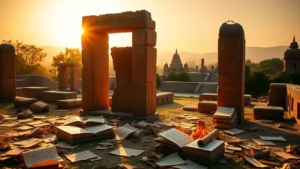
Several theories attempt to explain the library’s disappearance. Some historians believe it was destroyed during invasions or natural disasters, while others speculate it was deliberately hidden to protect its contents. The lack of concrete evidence has fueled endless debates, with some arguing the library may never have existed—at least not in the form described by legends.
Modern Searches for the Library
Over the years, numerous expeditions have sought to uncover the Golden Library, from British colonial archaeologists to independent researchers. Modern technology, including ground-penetrating radar and satellite imaging, has renewed hope, but no definitive traces have been found. The library’s possible locations—ranging from the ruins of Pataliputra to hidden caves in the Himalayas—remain speculative.
Challenges in the Search
The search is complicated by India’s vast and diverse landscape, centuries of urban development, and the scarcity of reliable historical records. Additionally, many potential sites are protected religious or cultural landmarks, making excavation difficult. Without a clear lead, the Golden Library remains as elusive as ever.
Why Finding It Matters
Discovering the Golden Library could revolutionize our understanding of ancient India. Its texts might offer new insights into Ashoka’s reign, early Buddhist philosophy, and lost scientific knowledge. For historians, archaeologists, and spiritual seekers alike, the library represents a potential key to unlocking forgotten wisdom.
The Impact on Indian Heritage
Beyond academic curiosity, the library’s recovery would be a monumental moment for India’s cultural heritage. It could reinforce the nation’s historical significance and inspire renewed interest in preserving ancient sites and manuscripts.
Frequently Asked Questions
Did the Golden Library of Ashoka really exist?
While there is no definitive proof, many historians believe Ashoka likely maintained a significant collection of texts. Whether it was a literal “golden library” or a more modest repository remains debated.
Where is the most likely location of the library?
Possible sites include Pataliputra (modern-day Patna), ancient monastic universities like Nalanda, or hidden caves in the Himalayas. However, no conclusive evidence points to a specific location.
What kind of texts might the library have contained?
It could have housed Buddhist scriptures, Ashoka’s edicts, scientific treatises, and records of diplomatic exchanges with other ancient civilizations.
Has anyone ever claimed to find the library?
No credible claims have been verified. Occasional rumors surface, but none have led to a confirmed discovery.
Could modern technology help locate the library?
Advanced archaeological tools like LiDAR and ground-penetrating radar offer hope, but without a clear starting point, the search remains challenging.
Conclusion
The lost Golden Library of Emperor Ashoka stands as one of history’s most tantalizing mysteries. Whether it was a grand repository of golden texts or a more modest collection, its potential to reshape our understanding of ancient India makes it a subject of enduring fascination. Until concrete evidence emerges, the library remains a legend—waiting, perhaps, for the right explorer to uncover its secrets.